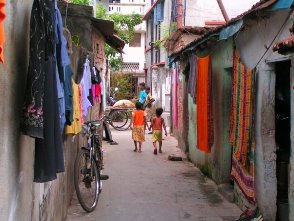
Thursday, 30 December 2010

The Simplicity of Necessity and the Simplicity of Surrender - lessons from our neighbours

“One thing I have asked of the Lord,

That will I seek after:

That I may dwell in the house of the Lord all the days of my life,

To behold the beauty of the Lord

And to inquire in His temple”

Psalm 27:4


For a long time, this has been a favourite verse of mine. What a beautiful place to be, dwelling, resting, in our Lord’s temple, with nothing else to do but enjoy His presence. As a mum of two small children, at first preparing to move and now living in an Asian slum, quite frankly, that rest is fairly inviting.

This invitation of rest and enjoyment of the Lord continues to beckon me further and further into His presence, but more recently I have come to see that rest and peace come from not only seeking His presence, but the reality of actually only having ‘one thing’ to ask of the Lord. As I have reflected, it has become clear to me that although I desired to dwell in the house of the Lord, I am unable to say it is the ‘one thing I ask’. In fact, it is one of many competing things I ask. My actions, decisions and activities are associated with many motivations, usually trying to please people, being impressive and looking good in the eyes of others. Try asking yourself for a day or a week with every new activity ‘what am I really doing this for?’ The answers can be quite revealing. Having our motivation stem from multiple desires or impressing multiple people (spouse, church family, co-workers, boss, even my under privileged neighbours with our simplicity) can make our lives very complex. The peace I'm so desiring moves further and further away.

On the other hand, if we can ground our thoughts and motivation around this one desire…to move continually closer to the presence of God, simplicity and its accompanying inner rest is within our reach. Richard Foster calls this making decisions out of our ‘Divine Centre’ (The Freedom of Simplicity p 99). This doesn’t mean reverting to the life of a monk, that we don’t make further decisions or take on further responsibilities. Rather that when our motivation and thoughts flow out of a desire for an ever closer relationship with our Creator, complexities of purpose and its accompanying time pressures, ego struggles and other things disastrous to inner simplicity can no longer steal us away from the joy that has been promised to us (John 15:11). As far as I can see, God doesn’t promise that a life lived in harmony with Him means less decisions, less external commitments or less busyness although a commitment to move towards a single purpose in him will likely produce this fruit. But it does make decisions easier when one path will lead me further away from His house and another leads me right to His arms.

Quite clearly this conscious decision to simplify the basis of all decisions and actions progresses naturally to a tangible simplicity of lifestyle. When I am no longer in pursuit of security, comfort or an ability to keep up with the Jones, the way is made clear for me to seek the heart of Christ in whichever manner He is inviting me to do so. What is not as obvious, at least at the outset, is the lessons to be learnt from those who have already lead a simple lifestyle not as a conscious decision, but as a necessity.
I am no expert on the topic of simplicity by any stretch of the imagination, but I have tasted enough to know that the things that I have allowed complicate my world, have also held me back from entering into communion with Christ’s heart completely. In my ever evolving journey of simplicity, one way Christ has invited me to know him is through his heart for the poor of this world. And one way he achieves this is giving me my urban poor neighbours as my teachers. Unbeknownst to them, my neighbours challenge me into stripping away things previously known to me as essentials. As a family of four, the children 3 and 2 years, even if we do this radical thing and move to a slum, we couldn’t possibly do it without running water, a flushing toilet, fridge. Or could we? As it turns out we can. It is important to note that for me to live without these things through the luxury of decision means a different thing than my neighbours who struggle with heavy loads of water across a railway track, illness from lack of sanitation and the like out of injustice and lack of opportunity. But in choosing to surrender in solidarity with them, I get closer to knowing and therefore loving the ones forgotten by society, progress, affluence, us, yet not forgotten by God. If I can know the heart of Christ by knowing the ones he looks out for, and if I can do that by living more simply than I ever imagined possible then I can honestly say my neighbours have blessed me more than I them. It is my prayer to somehow repay my debt to them.

Thursday, 11 November 2010

A prayer for the children

Just after writing about our neighbours here, our landlord asked them to leave because the boys were naughty. They left before I even knew they were leaving. I will always wonder what will become of those two boys. I think of the times I turned them away from playing or got impatient with their fighting. Could we have done more? Shown more love in the time we had with them? My prayer is that they will find a place where they are tolerated, and ultimately, their true refuge.

What is it about children anyway, that does tug at the heart strings? Why are we so endeared to them more than any other sub-group of humanity, particularly when they are in need? I have a theory..
With children, what we do now to them, with them and for them can be so influential. We have responsibility and opportunity.
Regardless of one's view on original sin, babies begin life untainted. True, child-like innocence is theirs. As yet uncorrupted, their trust is pure. And then life begins.
As parents and carers, we have an unparelleled treasure. A life to guard. A spirit of another human being to nurture and protect. Made in the image of God and with His handwriting already on their hearts, the task is next to overwhelming. I am not up to it.
I often think of the times I have yelled at my children, smacked them in anger, or perhaps missed sharing something special with them, even dismissing it because it was more important to them than to me. More than once I have wondered at me having the 'power' in the relationship when that power is able to corrupt, and when they have so much to teach me.  When childhood has such a bearing on all of life, even in shaping a psyche the guilt of influencing that to the detriment of my own children is sometimes suffocating. For me anyway, and I expect many mums, because my love for my children is consuming, so therefore is the guilt when that love fails.

I need Your power each minute to keep me from impatience, anger, pride, self-righteousness, inattentiveness.

I need Your Spirit to teach me to slow down and enjoy the moments of life.

I need you to somehow remove the unbearable guilt of failur, knowing that I can, have and will damage the most precious of souls. Oh Lord, how to let You be bigger than me??? How to let your goodness and plans for our children outweigh any harm we can bestow upon them. Children in my house and children playing across your earth. How to let your grace be sufficient - not just in the weaknesses I have, but in the weaknesses I cause. That our children may thrive because of you and despite of me.


Wednesday, 3 November 2010

The Spare Oom

"What will our children do in the morning? Will they wake with their hearts wanting to play, the way wings should? What will our children do in the morning if they do not see us fly?"

Jalaludin Rumi (1207-1273)

I never meant to care about the children here. Pictures on television and glossy brochures distributed by NGOs annoyed me with their heart-string-tugging clichedness. Little kids with pot bellies covered in flies staring listlessly. Or sometimes having a great time playing around the water pump. There was enough people to care about that, right? I had to find something different. (Those of you familiar with the enneagram will recognise some 4ness emerging here.)
But as I spend more time sitting on our front step watching our kids play with kids whose day includes playing around a water pump, through no fault of my own, I'm starting to care. It's apparent the lack of supervison and stimulation can really affect these kids. Actually, it's not all bad. The other day, some of them got a plastic bag, filled it with leaves and called it a football. Cool, Games still include nothing but imagination and a bunch of friends. Our kids won't know what an x-box, game cube, nintendo DS or playstation is for a very long time.

Recently a family moved into a little thatch room next to ours. Functionally, they consist of mum and two boys aged 6 and 2 (Dad works a lot). Their room is about 4 x 6 metres and is their bedroom, dining room, kitchen, laundry and living room. They are from another state so immediately face a language barrier. The boys, particularly when Mum is cooking in that small space, have nowhere else to go except wander between our house and our front step. It's pretty boring. And with such an expanse of waste water canal right in front of you, why wouldn't you throw things in? Aunty's cup and plate, and the toys from the white kids next door make great splashes! But now, the boys are in trouble. Not only from Mum, but from every Aunty within earshot. And this becomes the most interaction from adults for most of the day. Everyone says their piece and goes back to work. Mum goes back to cooking, now feeling condemned because not even a language barrier can hide the fact that all the women are talking about how naughty her boys are and that they should go back to where they came from. 


We rent two rooms here. One is our bedroom and dining room. The other is a playspace and 'school room' for our 2 and 3 year old. With a waste water canal and 2 railway tracks the prominent feature of our community, this space has been a blessing for us. There are number and alphabet posters hanging on the wall, and stars and moons made from cereal boxes and alfoil hanging from the ceiling.
Lately, it has also become a playspace for the other children in our community, who being kids, naturally gravitate there! It can be noisy, calm, creative and chaotic and (usually) we love it! It's nice to be able to provide a safe place for the kids to be allowed to play as well as provide a rest for the mums, who work so hard just to do everyday tasks of living in a slum. It's becoming one of the many little communities within our community and we are grateful for the privilege.


Monday, 1 November 2010

And we're back....

It's time to revive Ye Old Blogge. It's been awhile since my last post. It's a little ironic - it's been probably the most crazy time of my life, yet, what to write? Not for want of things to say, it just seemed as if putting the events of the last couple of months down on *ahem* paper would not do justice to the emotions involved. So I will not attempt, except for the brief summary below;

A) We moved into a slum whose main feature is waste water canal about a metre from our front door, and is sandwiched between two railway tracks.


B) A 21 year old from our community was subsequently killed on said railway tracks behind our house. The experience of grief with a Hindu community was both a privilege and a really hard time.

C) Our landlady turned into a dragon. Living at home was a little difficult. Looking for a new house so soon was an added stress. Since changing her mind about the whole dragon thing, things have been much more peaceful.


D) A health scare with our two year old. Hospital trips eat up time. Mental capacity diminished greatly. Thanks God for a happy ending.


And that's all I have to say about that. In other news, relationships with the neighbours are going well. Their names are Narkel, Sada, Naru and Cini. Unfortunately one of them fell of the roof yesterday (I'm not sure which one) and now will not come out from the safety of a narrow gap between two walls. Here they are in happier times...


Saturday, 7 August 2010

Why this life matters (Part 2)

Why This Life Matters (part 2).


“The wages of sin is death, but the gift of God is eternal life in Christ Jesus.” (Romans 6:23).

As Christians, we have a tendency to emphasis in our thoughts, words, choice of songs and study material, the hereafter. Eternal life. Eternity. The general assumption seems to be that this earthly life must end before eternal life can begin. What excites me is that we don’t have to wait. ‘The gift of God is eternal life’ which begins with our first transformational encounter with Jesus. Eternity in Christ Jesus has begun. WE don’t have to wait for physical death to experience whatever that means.

So what does that mean? It means that this life matters. If the wages of sin is death, then the opposite is true for a life lived in the grace of Jesus., including the earthly bit. Jesus himself demonstrated that this life matters. He didn’t just forgive sins and promise eternal life in His presence. He healed, he restored sight, he banished hunger. He began the restoration of a broken world, which will one day not be broken anymore. And the really really great bit is that we get to help in the restoration. The way we lve our lives either will or will not work towards restoration and healing – spiritually, physically, emotionally. But whichever we choose, eternity has begun. The life of the lady outside the cafe matters. Now.

Monday, 2 August 2010

This life matters

"And if you said 'this life ain't good enough', I'd give my world to lift yours up."


I must’ve heard these words a thousand times over the years. It’s a favourite song of mine, and as it seems any cafe in Dhaka or Kolkata that wants to appear remotely western. But as I heard Santana’s ‘Smooth’ this time, sitting in a clean, air conditioned cafe, I listened to this part again. There was a lady on the other side of the glass, the noisy, dirty, hot side, looking at me intentionally, and waiting for me to come out. I could tell by looking at her, before she even had a chance to hold her hand out to me and say ‘Didi (Sister,) that her life ain’t good enough.

Right now, our team is in the process of figuring out what it means to give our world to lift hers up and the too-many-to- count people just like her. Specifically, we are trying to discern our location in this vast city of need. It’s already difficult to meet people and listen to their stories – maybe a family who works on a vast mound of the city’s rubbish, scavenging amongst the pigs for recyclables. The children should be in school, but the more hands on in the rubbish, the more chances of being lucky that day. And then to meet another family, maybe this time a lady with two sons and an alcoholic husband living in one room of a condemned building. She is the only one in her family who doesn’t know she has leukemia. They can’t tell her, because then she will know that she should have more treatment, and they can’t afford to pay for it. Or the mother whose son was shot dead at random by someone in their own community.

Behind many many cottage doors in this city, there are similar stories. And the reality is, we will never know the half of it. With each new exploration comes lamentation. We lift these people up in prayer in grief and at the same time wonder if we will return to that area to live. We’ve spent the last month or so meeting the people that live behind some of these doors and listening to words of wisdom from other people who know the city much better than us, both nationals and foreigners. If you are one who prays, please join with us we pray about three specific areas of the city that seem like good possibilities to set up our new worlds.

Thursday, 17 June 2010

Bungled Bangla


Do you need a lesson in humility? One way to go about this is to attempt to learn a language and culture whilst immersed in the culture. This has really opened my eyes to what it must be like to be illiterate in my own culture. I have certainly felt very humbled. But as we wrap up our three months of formal language and cultural study, I’d like to share some of our lighter moments of not quite clearing the hurdle that is the English/Bangla barrier.


Most of these include Our Friend The ChaWallah (tea seller), herein called OFTCW.

*My friend told OFTCW that she was a mosquito.

*Another friend tried to ask OFTCW how many languages he knew. Instead he asked how much rent he paid.

*My beloved husband told OFTCW that he was going to marry my brother.

*I told some waiters at a restaurant after I had finished using the bathroom that I had no questions. (Although around SE Asia it wouldn’t have been unusual to have questions after using the bathroom.)

*I also told our language teacher that when our children wake during the night, we feed them chicken and salad sandwiches on Naan bread. With hand gestures to demonstrate how large the sandwich was. She was struck by the cultural difference. Bengalis give their children a glass of milk.

We are in good company. The founder of our organisation, when he moved into his first slum many years ago, wanted to ask where all the water pumps were. Instead he asked his extremely poor community where all the movie stars were. You gotta start somewhere.